
Dollar rate in Sri Lanka today
The Central Bank's indicative rate beside the banks' buying and selling boards, and what a round trip through the spread costs on a real amount.
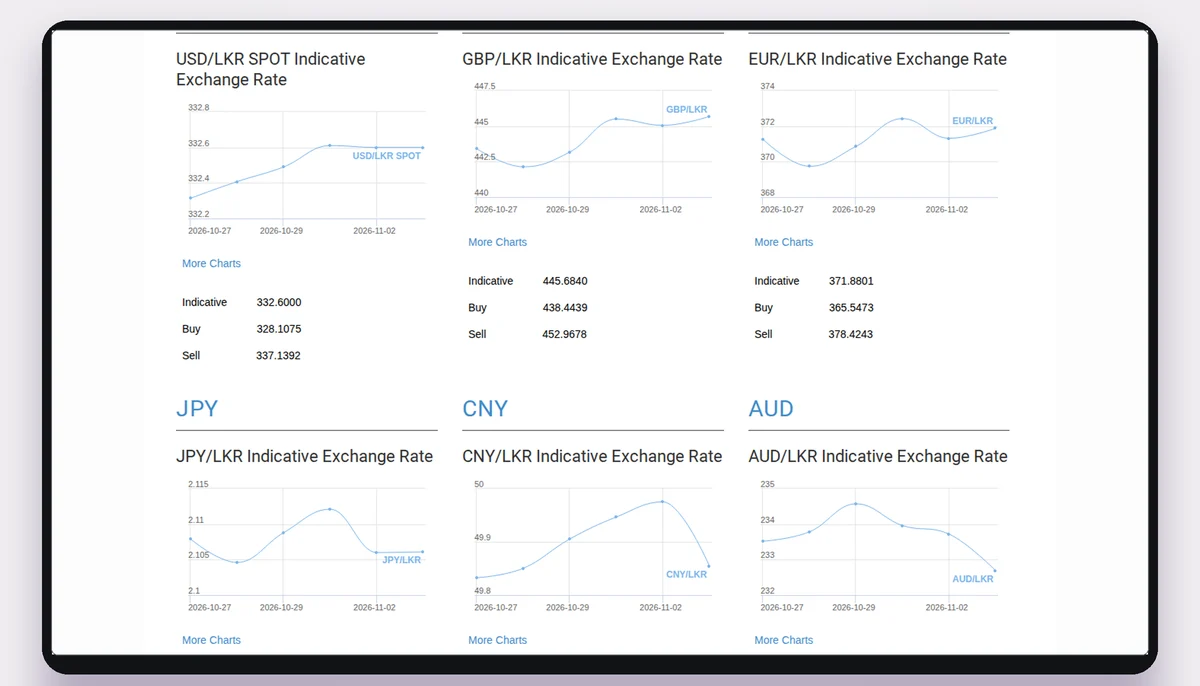
Today's dollar rate: the central bank and the banks' boards
Rate of: 02.11.2026| Board | Bank buys at | Bank sells at | Sells above indicative | Spread, % |
|---|---|---|---|---|
| Licensed banks, average telegraphic transfer | Rs 328.11 | Rs 337.14 | Rs +4.54 | 2.75% |
| People's Bank, telegraphic transfer | Rs 328.69 | Rs 336.36 | Rs +3.76 | 2.34% |
| People's Bank, notes | Rs 328.46 | Rs 336.60 | Rs +4.00 | 2.48% |
The Central Bank's indicative rate is the average of the previous business day's interbank deals; the banks' buy and sell quotes are what a customer is offered. The distance between them is what a bank earns on the dollar.
The indicative rate is a weighted average of the previous business day's interbank deals, not a price anyone is obliged to deal at.
Each licensed bank sets its own buy and sell rates for telegraphic transfers; the average of their opening quotes sits beside one bank's own board.
Buying dollars and selling them back the same day loses the whole of the bank's spread, which the live table works out on round amounts.
Five pages on the rate
Banks and the central bank
Where the indicative rate comes from, why banks quote around it, and what the opening-quote average means.
02What the spread costs
The round-trip cost on a thousand or five thousand dollars, and who pays the spread in a remittance, an import bill or a holiday.
03Day by day
The last two weeks of the indicative rate with the banks' average buy and sell beside it, and why the table does not forecast.
04Indicative rate and spot
What 'indicative' means, why the Central Bank stopped publishing a middle rate, and why the figure is a reference.
05Remittances and cards
Why the rate on a remittance or card statement differs from the indicative rate, and what to ask before sending money.
Dollars as a contract, not banknotes
FxPro offers currency pairs and gold as contracts for difference. No metal or banknotes are delivered; a contract is settled in the account's currency. Opening an account takes identification and a day or two, and a practice account costs nothing.