
What the spread costs on a round trip
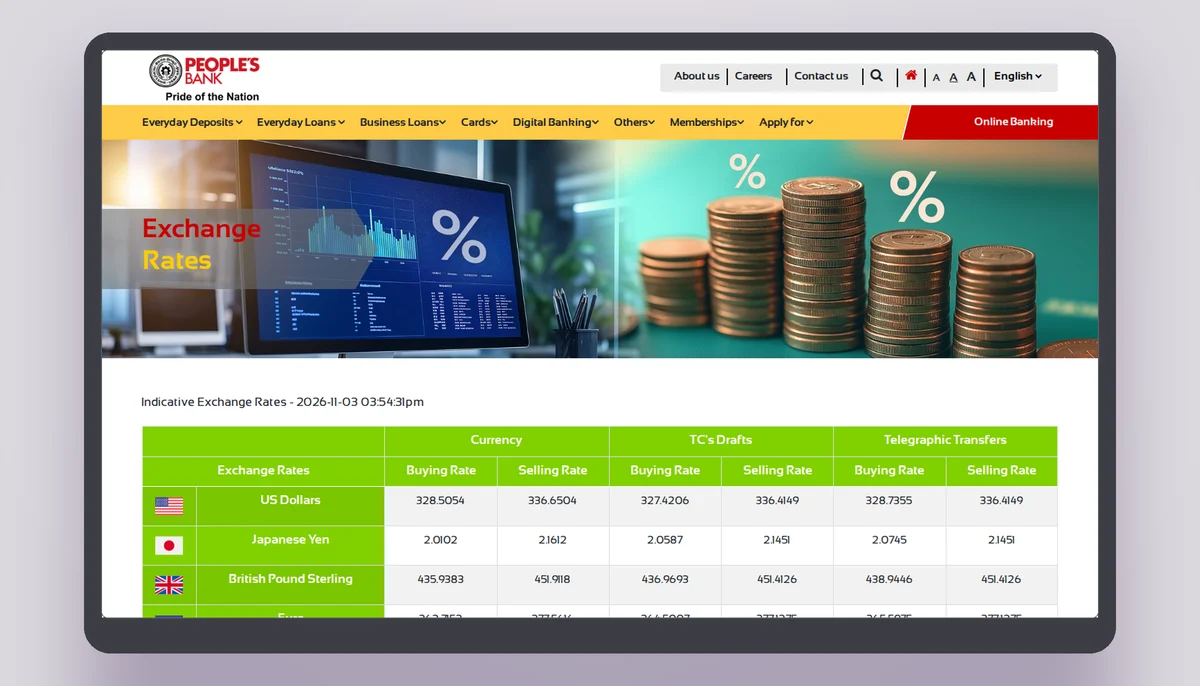
A bank sells dollars above the indicative rate and buys them below it. The spread is the difference between the bank's sell and buy quotes. If you buy dollars and then sell them back the same day, you pay the spread twice: once when you buy, once when you sell. The live table above this text works out the cost on round amounts, using the banks' average buy and sell and People's Bank's own board. The cost is the spread, and a quick round trip loses the whole of it.
What a round trip costs on an amount
The cost of buying dollars at the banks' average sell rate, the sum returned by selling at the average buy rate, and what is lost between them.
| Amount | At the indicative rate | Cost to buy | Returned if sold back | Round trip loses |
|---|---|---|---|---|
| $100 | Rs 33,260 | Rs 33,714 | Rs 32,811 | Rs 903 |
| $500 | Rs 166,300 | Rs 168,570 | Rs 164,054 | Rs 4,516 |
| $1,000 | Rs 332,600 | Rs 337,141 | Rs 328,109 | Rs 9,032 |
| $5,000 | Rs 1,663,000 | Rs 1,685,705 | Rs 1,640,545 | Rs 45,160 |
Rate of: 02.11.2026
The spread is the bank's charge
A bank's board has two prices: the sell rate, at which the bank sells you dollars, and the buy rate, at which the bank buys dollars from you. The sell rate is higher than the buy rate; the difference is the spread. The spread is the bank's charge for changing money, and it is paid by the customer on every transaction.
The spread covers the bank's risk of holding an open position in two currencies, the cost of handling cash or transfers, and the bank's margin. The wider the spread, the more the bank charges. The indicative rate is the reference; the spread is the distance between the bank's board and the indicative rate, on both sides.
A round trip loses the whole spread
If you buy dollars at the bank's sell rate and then sell them back at the bank's buy rate, you lose the spread. The sell rate is above the indicative rate, and the buy rate is below it; the difference between them is the spread. You pay the spread once when you buy and once when you sell, so a quick round trip loses the whole of it.
The live table above this text shows the cost of buying and selling back the same amount, using the banks' average buy and sell and People's Bank's own board. The cost is the spread multiplied by the amount of dollars. The table works out the cost on round amounts, so you can see what the bank takes.
Who pays the spread
A traveller buying dollars for a trip pays the spread when buying. If the traveller returns with leftover dollars and sells them back, the spread is paid again. An importer paying a supplier in dollars pays the spread when buying dollars to make the payment. A family receiving a remittance pays the spread when the dollars are converted to rupees: the receiving bank buys the dollars at its buy rate, which is below the indicative rate.
The spread is paid by the person on the other side of the bank's board. The bank always sells above the indicative rate and buys below it, so the customer always pays the spread. The cost is the same mechanism for a traveller, an importer or a remittance receiver: the bank's board is the transaction price, and the indicative rate is only the reference.
The live table's columns
The table above this text has columns for the amount of dollars, the buy rate, the sell rate, and the cost of the round trip. The buy rate is what the bank pays you for dollars; the sell rate is what you pay the bank for dollars. The cost is the difference between the two, multiplied by the amount.
The table shows the cost on round amounts, using the banks' average buy and sell and People's Bank's own board. The banks' average is the mean of the licensed banks' 9.30 a.m. telegraphic-transfer quotes; People's Bank's board is one bank's quote. The cost is the spread, and it is paid once when dollars are bought and once when they are sold.
Why the spread changes
The spread is not fixed. It can widen when the market is volatile, when a bank has a shortage of dollars, or when the bank perceives more risk. It can narrow when competition between banks is strong, or when a bank has a surplus of dollars. The Central Bank's indicative rate moves with the interbank market, but the spread is set by each bank independently.
The average of the banks' opening quotes smooths the differences between banks, but the spread on the average is still a real cost. A reader who wants the best rate should compare the boards of several banks, because the spread can differ. The live table shows the average and one bank's board, so the reader can see the range.
The spread on large amounts
The spread is a percentage of the amount, so the cost in rupees is larger on a larger amount. The live table shows the cost on round amounts, so the reader can see how the cost scales. A bank may negotiate a narrower spread for a large transaction, but the published board is the starting point.
An importer paying a supplier in dollars, a traveller buying a large sum, or a family receiving a large remittance should ask the bank for a better rate than the published board. The bank may be willing to narrow the spread for a large amount, but the indicative rate is still the reference. The cost of the spread is the bank's charge, and it is paid by the customer.
Key facts
Read next
Questions about today's rate
What is the spread?
The spread is the difference between the bank's sell rate and its buy rate. The bank sells dollars above the indicative rate and buys them below it; the spread is the bank's charge for changing money. It is paid by the customer on every transaction.
How much does a round trip cost?
A round trip of buying dollars and selling them back the same day loses the whole of the spread. The cost is the spread multiplied by the amount of dollars. The live table above this text shows the cost on round amounts, using the banks' average and People's Bank's board.
Why does a remittance receiver pay the spread?
When a remittance arrives in dollars, the receiving bank converts it to rupees at the bank's buy rate, which is below the indicative rate. The difference between the buy rate and the indicative rate is the spread, and it is paid by the receiver. The sender may also pay fees, which are separate from the rate.
Can I avoid the spread?
No. The spread is the bank's charge for changing money, and every bank charges it. You can reduce the cost by comparing the boards of several banks and by asking for a better rate on a large amount, but the spread is always paid.
Is the spread the same at all banks?
No. Each bank sets its own board, and the spread can differ. The average of the licensed banks' 9.30 a.m. telegraphic-transfer quotes is a mean, but individual banks may have wider or narrower spreads. People's Bank's board is shown separately in the live table.
Dollars as a contract, not banknotes
FxPro offers currency pairs and gold as contracts for difference. No metal or banknotes are delivered; a contract is settled in the account's currency. Opening an account takes identification and a day or two, and a practice account costs nothing.