
The central bank's rate and the banks' boards
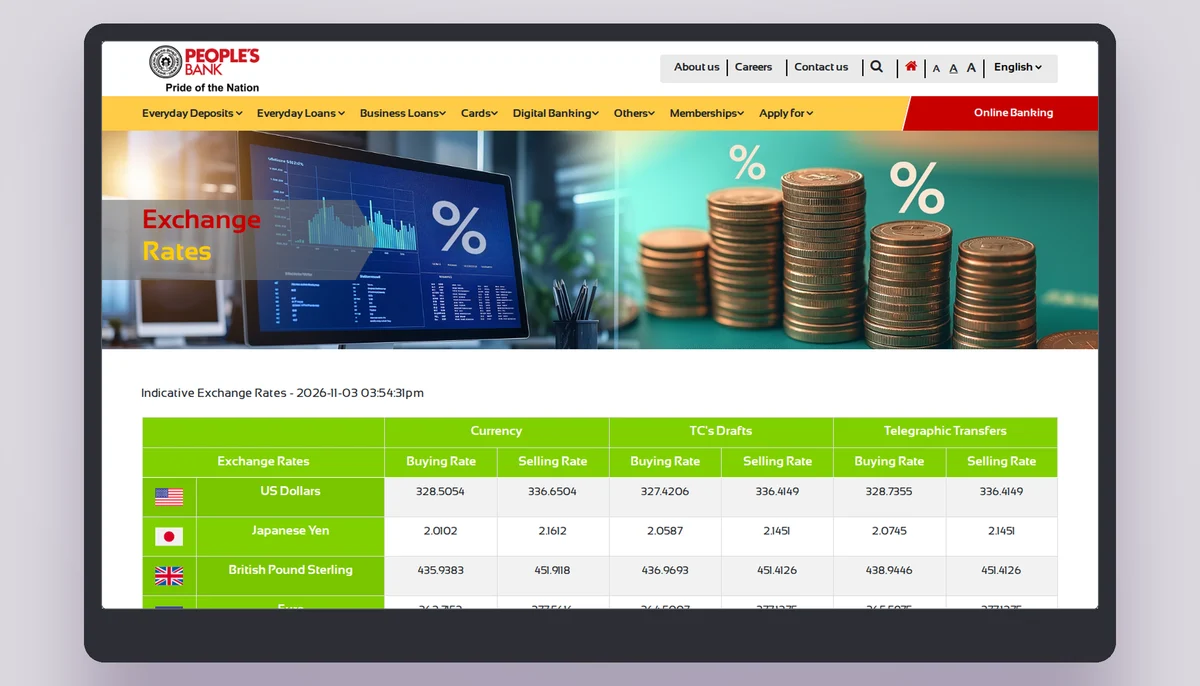
The Central Bank of Sri Lanka publishes an indicative USD/LKR spot rate each business day. It is a weighted average of the previous business day's interbank spot deals, including the bank's own interventions. The licensed banks publish their own buy and sell telegraphic-transfer quotes; the Central Bank averages the quotes given at 9.30 a.m. and publishes that average. One bank's board, People's Bank, is shown separately with its telegraphic-transfer and currency-note pairs. The live table above this text shows the indicative rate, the average of the banks' opening quotes, and People's Bank's own board.
The central bank's rate and the banks' boards
The indicative rate, the average of the licensed banks' quotes and one bank's own board, with each one's distance from the indicative rate.
| Board | Bank buys at | Bank sells at | Sells above indicative | Spread, % |
|---|---|---|---|---|
| Licensed banks, average telegraphic transfer | Rs 328.11 | Rs 337.14 | Rs +4.54 | 2.75% |
| People's Bank, telegraphic transfer | Rs 328.69 | Rs 336.36 | Rs +3.76 | 2.34% |
| People's Bank, notes | Rs 328.46 | Rs 336.60 | Rs +4.00 | 2.48% |
Rate of: 02.11.2026
The indicative rate is a reference, not a price
The Central Bank's indicative rate is a weighted average of the previous business day's interbank spot deals, including the bank's own interventions. It is a summary of where the market traded, not an offer to anyone. A bank is not obliged to deal at the indicative rate, and no customer can demand it. It is the figure the news prints, and it is the reference against which the banks' boards are measured.
The average of the licensed banks' telegraphic-transfer quotes at 9.30 a.m. is a summary of opening offers. Each bank sets its own board, and the average hides the differences between banks. A reader who wants a transaction price must look at a bank's board, not at the average.
Why a bank sells above and buys below the indicative rate
A bank holds inventory in two currencies. When it sells dollars, it gives up dollars and takes rupees; when it buys dollars, it gives up rupees and takes dollars. The bank must manage the risk that the rupee moves while it holds an open position. The spread between the bank's buy and sell quotes covers that risk, the cost of handling cash or transfers, and the bank's margin.
The indicative rate is a weighted average of interbank deals, which are large and between banks. A retail customer's transaction is smaller and carries more handling cost, so the bank sells above the indicative rate and buys below it. The spread is the bank's charge for changing money, and it is paid by the customer on every transaction.
The average of the banks' opening quotes and one bank's board
The Central Bank publishes the mean of the telegraphic-transfer quotes that licensed banks give at 9.30 a.m. The average is a snapshot of the opening of the business day; the market can move after the quotes are taken. A bank may change its board during the day, and the average will not reflect that. The live table shows the average buy and sell, labelled as an average of the banks.
People's Bank's own board is read from the bank's published page, which carries its own timestamp. The telegraphic-transfer and currency-note pairs are shown separately. A currency-note rate is for banknotes, and it typically has a wider spread than the telegraphic-transfer rate because handling cash costs more. The bank's board is a quote, not an average, and it is the price a customer of that bank meets.
The live table's columns and rows
The table above this text has columns for the indicative rate, the banks' average buy and sell, and People's Bank's buy and sell for telegraphic transfers and currency notes. The indicative rate is one number; the banks' average is a mean of several banks' opening quotes; People's Bank's board is one bank's quote. The rows are labelled so the reader can tell which is which.
The indicative rate is the reference; the banks' average buy and sell are the opening quotes of the licensed banks; People's Bank's board is a single bank's quote. The table does not show a rate that changes during the day; it shows the opening snapshot and the previous business day's average. The market moves after the quotes are taken, and a reader who wants a current price must ask a bank.
What moves the rate and the boards
The rupee floats, and the indicative rate moves on export earnings, remittances, import demand, central bank intervention and world markets. The banks' boards move with the indicative rate, but each bank sets its own spread. A bank with a large dollar position may narrow its spread to attract sellers; a bank with a shortage may widen it. The average of the opening quotes smooths these differences.
The indicative rate is published once per business day, after the interbank market closes. The banks' boards are set at the opening of the next business day. A reader who wants to know the rate before a transaction should look at the bank's board, not at the indicative rate, because the bank's board is the price the bank will actually deal at.
The Central Bank's role in the market
The Central Bank intervenes in the interbank market to smooth volatility and to manage liquidity. Its interventions are included in the indicative rate, because the rate is a weighted average of all interbank spot deals, including the bank's own. The Central Bank does not set a retail rate; it sets policy rates and conducts open market operations.
The indicative rate is a reference, not a target. The Central Bank has stated that it does not target a specific level for the rupee, and the rate is allowed to move with market forces. The banks' boards are set independently by each bank, and the Central Bank does not approve them. A reader who wants to know the Central Bank's view should read its monetary policy statements, not the indicative rate alone.
Key facts
Read next
Questions about today's rate
Why is the indicative rate different from the bank's rate?
The indicative rate is a weighted average of the previous business day's interbank deals, including the central bank's own interventions. A bank's rate is its own quote, set to cover its costs and risk. The bank sells above the indicative rate and buys below it; the difference is the spread, which is the bank's charge for changing money.
What is the average of the banks' telegraphic-transfer quotes?
It is the mean of the buy and sell quotes that licensed banks give at 9.30 a.m., published by the Central Bank. It is a snapshot of the opening of the business day, and the market can move after the quotes are taken. It is not a price any single bank is obliged to honour.
Why does People's Bank have two boards?
People's Bank publishes a telegraphic-transfer board and a currency-note board. The telegraphic-transfer rate is for electronic transfers; the currency-note rate is for banknotes. The currency-note spread is usually wider because handling cash costs more.
Can I deal at the indicative rate?
No. The indicative rate is a reference, not an offer. No bank is obliged to deal at it. You must deal at a bank's board, which will be above the indicative rate when you buy dollars and below it when you sell.
How often do the banks change their boards?
Banks can change their boards during the day, especially if the market moves. The average of the 9.30 a.m. quotes is fixed at that time; it does not update. A bank's own board may carry a timestamp, and you should ask the bank for its current quote before a transaction.
Dollars as a contract, not banknotes
FxPro offers currency pairs and gold as contracts for difference. No metal or banknotes are delivered; a contract is settled in the account's currency. Opening an account takes identification and a day or two, and a practice account costs nothing.